Homework for the last class will be an extension of this game. At home, select a short, familiar tune and write it down by ear. In class, each student will take a turn leading the others in dictation of their tune.
In addition, Lior has four "cells" to practice:
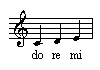
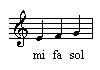
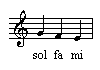
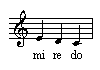
(Practice executing these in random order.)

This was great for that person, but not so hot for the class moving forward as a whole. Homework is the same as last week, the rhythms in 3/4.

There are actually only two other possible permutations of these three notes. Can you think of them?
Homework for the gentlemen in the class is still to focus on the first five melodies. I'm hoping I can pass you on these next week!
Also, we practiced conducting and "ta"-ing in 3/4. Homework is to do the 3/4 rhythms in the back of the packet, nos. 5-7, 15 and 16.
We finished off with a lot of "call and response" and some dictation. Remember that you can practice dictation online with Web Dictation.
Then I tried to convince Irmgard and Rebecca that they should try to "push through" the melodic material by simply "using their own do" and sight-reading without piano. (More realistically, this probably means using the piano a minimal amount, when one is unsure about a note.) Their homework is to read through pages 1-2, maybe even 3 if there is time.
Homework for Lior and Gabe, however, is the same as last week - carefully practice melodies 1-5. Move them to other keys if they are uncomfortable to sing. The guys are still working on confident singing, not fast reading.
Finally, I pulled out my laptop and showed off my online practice materials - web dictation and singing cells (for PC.) Everybody is encouraged to try this stuff.
Next class is April 21.
We returned to our bass clef practice in the dandelot. Homework is to go slightly deeper into the packet, from exercises 6-8.
We sang some melodies and heard the assigned melodies from last week. Lior and Gabe should practice the very beginning of the melodies packet, nos. 1-5. I would still be happy to hear Rebecca's assigned melodies next week!
Finally, we went back to our conducting and "ta"-ing. Homework is just to continue practicing your 4/4 pattern (perhaps conducting along with a recording?) and to review the 4/4 rhythms in the back of the packet (nos. 1-4, 8-10.)
Homework is to do more bass clef practice with Dandelot, specifically numbers 5 and 6. Let's also continue to practice 4/4 rhythms in the back of the big packet, namely Nos. 8-10. Finally, I assigned individuals two melodies to prepare in the big packet.
Rebecca: Nos. 7 & 8
Irmgard: Nos. 10 & 11
Lior: Nos. 11 & 12
Remember that these weekly assignments are just "goals," and it's perfectly OK if you are not able to prepare all of this.
While the first session was kind of a "show and tell" for the general idea of the class, this session was more about digging in to some basics - bass clef reading and rhythmic reading (with conducting.)
Bass Clef Reading with Dandelot
I gave out pages from Georges Dandelot's Manuel pratique and we practiced naming off the note names (simply saying "F C F" etc.) Homework is to practice exercises 1-5. In case what to do is still unclear, I made a YouTube video which demonstrates.
Reciting (and Conducting) Rhythms in 4/4
Also, we started our first serious rhythmic practice. Homework is to practice Nos. 1-4 in our Easy Rhythms handout (which should be in the back of your big ear training packet.) You can try counting them out (like "one and two and three") and tapping on a table or some such thing, and I would also like you to try your hand at conducting. When we conduct, the arm motion takes the place of counting, so we can just conduct and say the rhythm as "ta ta ta." I've made a handout on how to conduct in four, and I did another YouTube video about it as well.
I gave out our text for the class, the Melodies for Sight Singing Packet. (Also the Easy Rhythms for In-Class Practice unit should be attached in the back of it.)
I encourage you to poke around here for more activities to do at home. You can try your hand at my web dictation units, or, if you have a PC I recommend my program singing cells.
I'm looking forward to a productive and musical semester!